Our app needs two custom objects: document templates (what to write) and documents (the generated result). Let’s define them. Scaffold each entity file with the CLI — it generates a valid UUID and the right folder for you:
yarn twenty dev:add object
Below we show the finished files.
Every *_UNIVERSAL_IDENTIFIER constant lives in src/constants/universal-identifiers.ts and is imported where used. The snippets below omit those imports for brevity — keep them in your own files.

The template object

A template has a name, a body with {{placeholders}}, and a target that says whether it’s written for a Person or a Company. The body is a RICH_TEXT field, so Twenty gives it a full rich-text editor.
import { defineObject, FieldType } from 'twenty-sdk/define';

export default defineObject({
  universalIdentifier: DOCUMENT_TEMPLATE_OBJECT_UNIVERSAL_IDENTIFIER,
  nameSingular: 'documentTemplate',
  namePlural: 'documentTemplates',
  labelSingular: 'Document template',
  labelPlural: 'Document templates',
  icon: 'IconFileText',
  labelIdentifierFieldMetadataUniversalIdentifier:
    TEMPLATE_NAME_FIELD_UNIVERSAL_IDENTIFIER,
  fields: [
    { universalIdentifier: TEMPLATE_NAME_FIELD_UNIVERSAL_IDENTIFIER,
      type: FieldType.TEXT, name: 'name', label: 'Name', icon: 'IconAbc' },
    { universalIdentifier: TEMPLATE_BODY_FIELD_UNIVERSAL_IDENTIFIER,
      type: FieldType.RICH_TEXT, name: 'body', label: 'Body', icon: 'IconFileText',
      description: 'Use {{placeholders}} like {{name.firstName}} or {{jobTitle}}.' },
    { universalIdentifier: TEMPLATE_TARGET_FIELD_UNIVERSAL_IDENTIFIER,
      type: FieldType.SELECT, name: 'target', label: 'Target', icon: 'IconTarget',
      defaultValue: `'PERSON'`,
      options: [
        { id: TEMPLATE_TARGET_OPTION_PERSON_UNIVERSAL_IDENTIFIER,
          value: 'PERSON', label: 'Person', color: 'blue', position: 0 },
        { id: TEMPLATE_TARGET_OPTION_COMPANY_UNIVERSAL_IDENTIFIER,
          value: 'COMPANY', label: 'Company', color: 'green', position: 1 },
      ] },
  ],
});
SELECT option values must be UPPER_CASE (PERSON, not person), and the defaultValue is wrapped in extra quotes: `'PERSON'`. The label is what users see.

The document object

The generated document stores the rendered content and a status. Define it the same way, with a status select of DRAFT / GENERATED. Full file: document.object.ts.

Linking them with a relation

Each document should point back to the template it came from. Relations are bidirectional — you define both sides, each in its own field file.
import { defineField, FieldType, OnDeleteAction, RelationType } from 'twenty-sdk/define';

// The "many" side: each document belongs to one template.
export default defineField({
  universalIdentifier: DOCUMENT_TEMPLATE_FIELD_UNIVERSAL_IDENTIFIER,
  objectUniversalIdentifier: DOCUMENT_OBJECT_UNIVERSAL_IDENTIFIER,
  type: FieldType.RELATION,
  name: 'template',
  label: 'Template',
  relationTargetObjectMetadataUniversalIdentifier:
    DOCUMENT_TEMPLATE_OBJECT_UNIVERSAL_IDENTIFIER,
  relationTargetFieldMetadataUniversalIdentifier:
    TEMPLATE_DOCUMENTS_FIELD_UNIVERSAL_IDENTIFIER,
  universalSettings: {
    relationType: RelationType.MANY_TO_ONE,
    onDelete: OnDeleteAction.SET_NULL,
    joinColumnName: 'templateId',
  },
});
The other side (template-documents-relation.field.ts) is a RelationType.ONE_TO_MANY field named documents that points the opposite way. See Relations for the full pattern.

See it in Twenty

With yarn twenty dev running, open Settings → Data model. Both objects appear, tagged with your app.
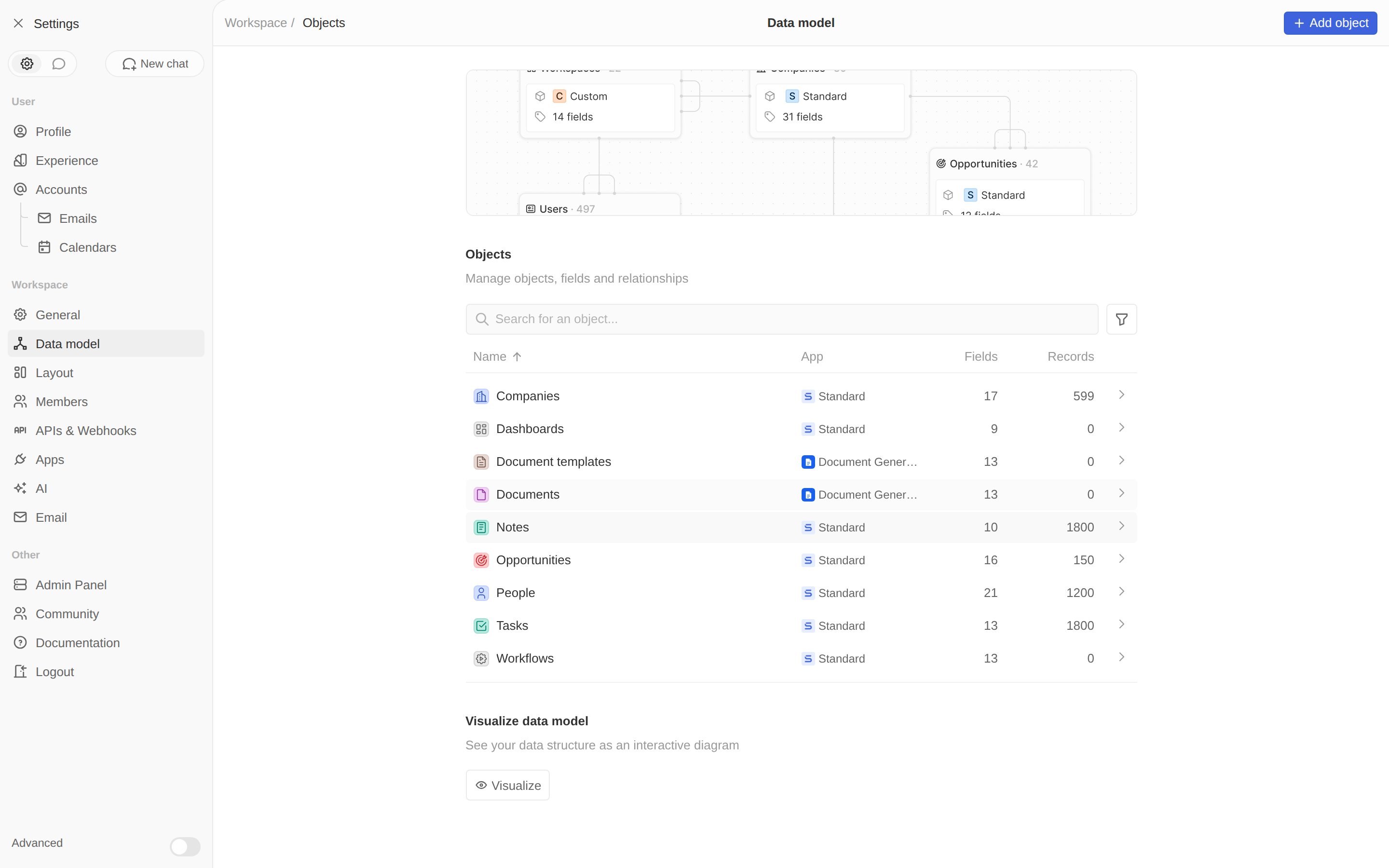
Data model settings showing Documents and Document templates
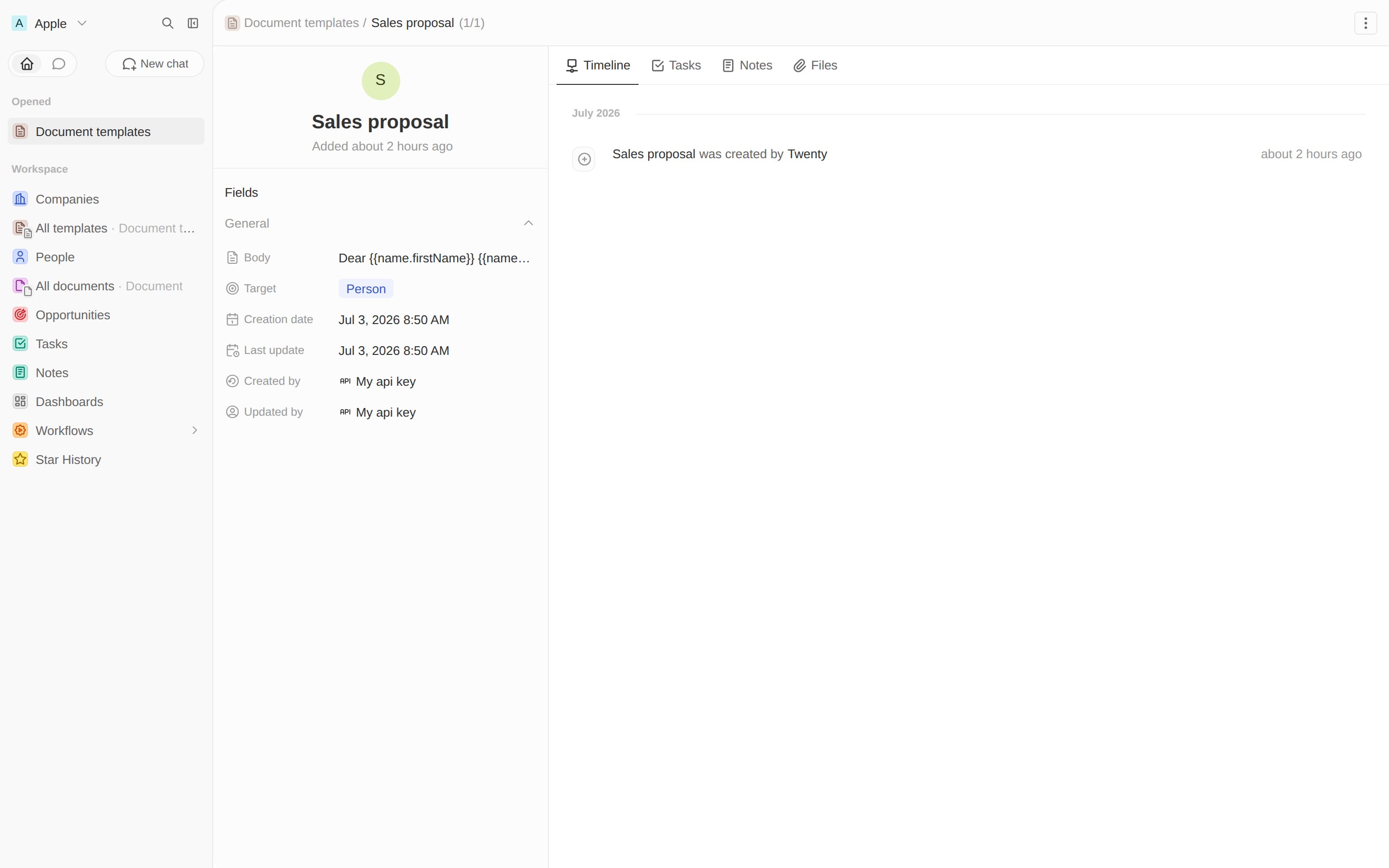
Create one template to test with — name it Sales proposal, set Target to Person, and paste a body with a few placeholders:
Dear {{name.firstName}} {{name.lastName}},

As {{jobTitle}} at {{company.name}}, we think you'll love our product.

Best,
The Team
A Sales proposal template record with placeholder body
After this step: you have documentTemplate and document objects, linked by a relation, and one template to generate from. Next, the logic that fills it in.

Next: generating documents →

Write the logic function that fills the template.