Ana içeriğe atla
Use this pattern to keep Twenty in sync with product data from your data warehouse (e.g., Snowflake, BigQuery, PostgreSQL).

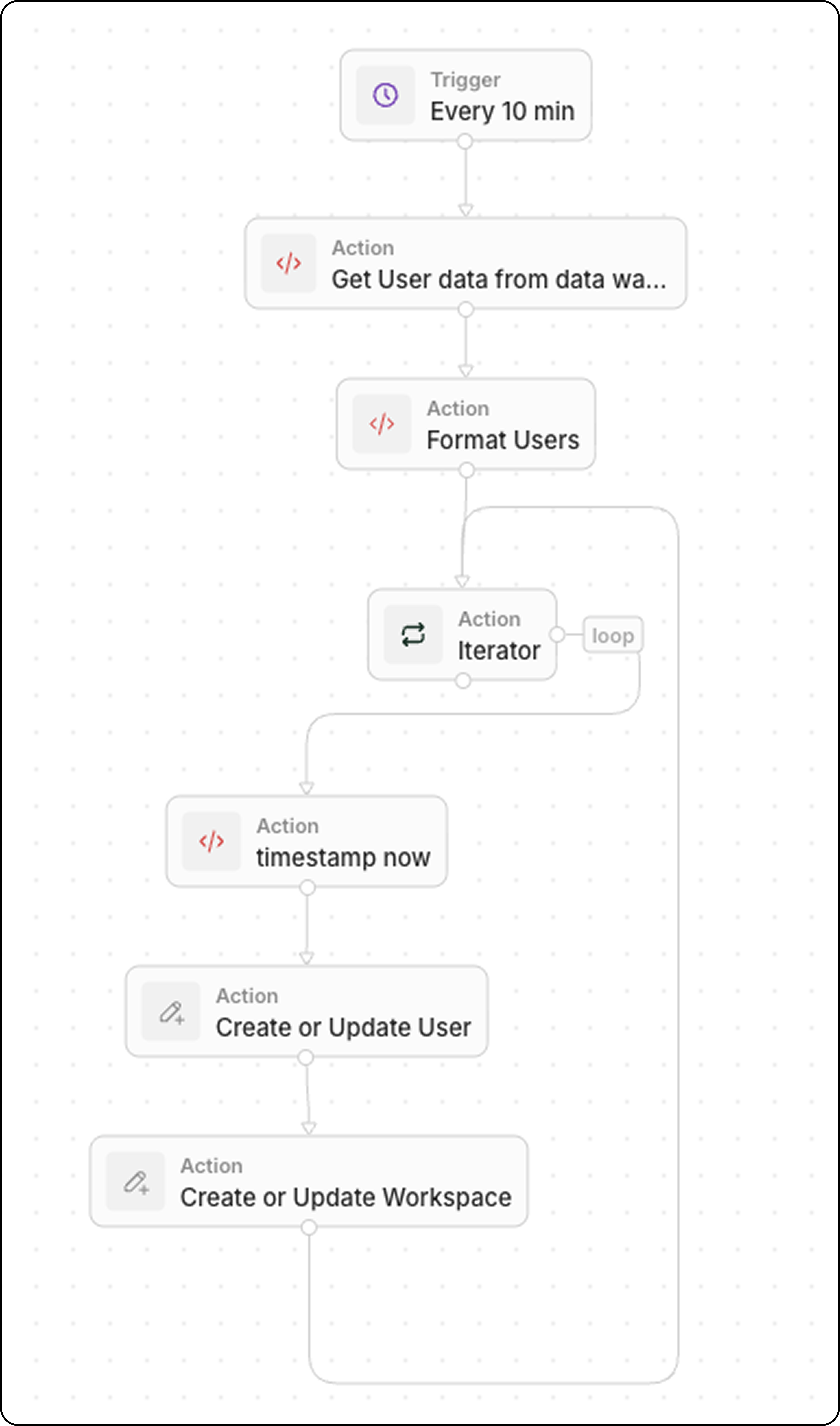
Workflow Structure

  1. Trigger: On a Schedule
  2. Code: Query your data warehouse
  3. Code (optional): Format data as array
  4. Iterator: Loop through each product
  5. Upsert Record: Create or update in Twenty

Step 1: Schedule the Trigger

Set the workflow to run at a frequency matching your data freshness needs:
  • Every 5 minutes for near real-time sync
  • Every hour for less critical data
  • Daily for batch updates

Step 2: Query Your Data Warehouse

Add a Code action to fetch recent data:
export const main = async () => {
  const intervalMinutes = 10; // Match your schedule frequency
  const cutoffTime = new Date(Date.now() - intervalMinutes * 60 * 1000).toISOString();

  // Replace with your actual data warehouse connection
  const response = await fetch("https://your-warehouse-api.com/query", {
    method: "POST",
    headers: {
      "Authorization": "Bearer YOUR_API_KEY",
      "Content-Type": "application/json"
    },
    body: JSON.stringify({
      query: `
        SELECT id, name, sku, price, stock_quantity, updated_at
        FROM products
        WHERE updated_at >= '${cutoffTime}'
      `
    })
  });

  const data = await response.json();
  return { products: data.results };
};
Filter by updated_at >= last X minutes to retrieve only recently changed records. This keeps the sync efficient.

Step 3: Format Data (Optional)

If your warehouse returns data in a format that needs transformation, add another Code action. Common transformations include type conversions, field renaming, and data cleanup.

Example: User Data with Boolean and Status Fields

export const main = async (params: {
  users: any;
}): Promise<object> => {
  const { users } = params;
  const usersFormatted = typeof users === "string" ? JSON.parse(users) : users;

  // Convert string "true"/"false" to actual booleans
  const toBool = (v: any) => v === true || v === "true";

  return {
    users: usersFormatted.map((user) => ({
      ...user,
      activityStatus: String(user.activityStatus).toUpperCase(),
      isActiveLast30d: toBool(user.isActiveLast30d),
      isActiveLast7d: toBool(user.isActiveLast7d),
      isActiveLast24h: toBool(user.isActiveLast24h),
      isTwenty: toBool(user.isTwenty),
    })),
  };
};

Example: Product Data with Type Conversions

export const main = async (params: { products: any }) => {
  const products = typeof params.products === "string"
    ? JSON.parse(params.products)
    : params.products;

  return {
    products: products.map(product => ({
      externalId: product.id,
      name: product.name,
      sku: product.sku,
      price: parseFloat(product.price),        // String → Number
      stockQuantity: parseInt(product.stock_quantity),
      isActive: product.status === "active"    // String → Boolean
    }))
  };
};

Example: Date and Currency Formatting

export const main = async (params: { deals: any }) => {
  const deals = typeof params.deals === "string"
    ? JSON.parse(params.deals)
    : params.deals;

  return {
    deals: deals.map(deal => ({
      ...deal,
      // Convert Unix timestamp to ISO date
      closedAt: deal.closed_timestamp
        ? new Date(deal.closed_timestamp * 1000).toISOString()
        : null,
      // Ensure amount is a number (remove currency symbols)
      amount: parseFloat(String(deal.amount).replace(/[^0-9.-]/g, "")),
      // Normalize stage names
      stage: deal.stage?.toLowerCase().replace(/_/g, " ")
    }))
  };
};

Common Transformations

Source FormatTarget FormatKod
"true" / "false"true / falsev === true || v === "true"
"123.45"123.45parseFloat(value)
"active""ACTIVE"value.toUpperCase()
1704067200 (Unix)ISO datenew Date(v * 1000).toISOString()
"$1,234.56"1234.56parseFloat(v.replace(/[^0-9.-]/g, ""))
null / undefined""value || ""

Step 4: Iterate Through Products

Add an Iterator action:
  • Input: {{code.products}}
This loops through each product in the array.

Step 5: Upsert Each Record

Inside the iterator, add an Upsert Record action:
SettingDeğer
ObjectYour custom Product object
Match byExternal ID or SKU (unique identifier)
Name{{iterator.item.name}}
SKU{{iterator.item.sku}}
Price{{iterator.item.price}}
Use Upsert (update or create) instead of building separate branches for create vs. update. It’s faster to build and easier to debug.

Example Use Cases

KaynakVeri
ERP systemProduct catalog, pricing, inventory
E-commerce platformOrders, customers, product updates
Data warehouseAggregated metrics, enriched data
Inventory systemStock levels, reorder alerts